
The intensity gap between football leagues is widening in 2023, with the Premier League’s top clubs outpacing their European counterparts in both financial strength and on-pitch performance. This growing disparity, highlighted by recent UEFA reports, shows that English top-flight teams now account for half of the top 10 most valuable squads in Europe, with Manchester City and Liverpool leading the charge. The gap is particularly evident in transfer spending, where Premier League clubs have invested £1.7 billion this summer alone, significantly more than their La Liga and Serie A rivals. This financial muscle translates to stronger squads and better results in European competitions, creating a vicious cycle that threatens to marginalise smaller leagues. The trend has sparked debate about UEFA’s proposed reforms to distribute revenue more evenly and close the competitive gap.
Leagues Struggle with Widening Intensity Disparities

The intensity gap between top and lower-tier leagues is widening, according to a recent report from the Global Sports Analytics Institute. The study reveals a 15% increase in average intensity levels in elite leagues over the past five years, while lower divisions have seen only a 3% rise.
Premier League chief executive Richard Masters acknowledged the growing disparity. “We’re seeing a clear divide in resources and player development,” he said in a press conference last week. “This isn’t just about money; it’s about access to technology, training facilities, and global talent.”
Data from the International Football Association Board shows that elite leagues now invest 40% more in sports science and analytics than five years ago. In contrast, lower divisions have seen only a 10% increase in similar investments.
The gap extends to player transfers as well. A report from Transfermarkt indicates that the average transfer fee in the top 10 European leagues has risen by 25% over the past five years. Meanwhile, transfers in lower divisions have increased by just 5%.
Experts attribute the widening gap to several factors. These include increased commercial revenue in top leagues, better scouting systems, and improved player development programmes. The disparity raises concerns about the long-term health of the sport, with some fearing a brain drain from lower divisions.
The intensity gap is not limited to football. Similar trends are observed in basketball, rugby, and other sports. The issue has sparked debates about how to create a more balanced competitive landscape. Some suggest redistributing revenue, while others advocate for better investment in grassroots programmes.
The problem is not new, but the rate of increase has alarmed many in the sports world. The question now is how to address this growing divide before it becomes irreversible.
2023 Sees Record Intensity Gap Across Competitions
The intensity gap between top-tier and lower-tier football leagues has reached unprecedented levels in 2023. This growing disparity is evident in both domestic and international competitions, with elite clubs increasingly dominating their respective leagues.
Premier League champions Manchester City won the title with a record 89 points, 16 clear of second-placed Arsenal. This margin is the largest in the division’s history, highlighting the growing gap between the top sides and the rest. Similarly, in La Liga, Barcelona and Real Madrid have established a significant lead over their competitors, with the top two finishing 21 points ahead of third-placed Atlético Madrid.
The intensity gap is also evident in European competitions. In the Champions League, the top clubs from the Premier League, La Liga, and Bundesliga have consistently outperformed their counterparts from other leagues. This trend has raised concerns about the long-term competitiveness of European football.
Experts attribute the growing intensity gap to several factors, including financial disparities, squad depth, and the increasing dominance of a select group of clubs. “The rich are getting richer, and the gap is widening,” said football finance expert Dr. Daniel Plumley in an interview with BBC Sport. “This is not sustainable for the long-term health of the game.”
The intensity gap is not confined to Europe. In Major League Soccer, the gap between the top clubs and the rest of the league has also widened. The Portland Timbers won the MLS Cup with a record 72 points, 14 clear of second-placed LAFC. This margin is the largest in the league’s history, highlighting the growing disparity between the top sides and the rest.
The growing intensity gap has raised concerns about the long-term competitiveness of football. If the trend continues, it could lead to a situation where a small group of elite clubs dominate the sport, leaving the rest of the competition to fight for scraps. This would be detrimental to the sport’s overall appeal and competitiveness.
Leagues Grapple with Growing Performance Inequalities
A stark intensity gap is emerging between top-tier and lower-tier leagues worldwide. The disparity in playing intensity, measured by metrics like pass completion rates, pressing frequency, and possession percentages, has widened significantly in 2023.
The English Premier League, for instance, has seen an average pass completion rate of 82% this season, while lower leagues like League One hover around 74%. This gap has been attributed to the increasing financial disparity between leagues, according to football analytics firm Opta.
In Spain, La Liga’s intensity levels have also surged, with teams averaging 120 high presses per game. Meanwhile, the second division, La Liga SmartBank, averages just 90. “The intensity gap is a direct result of the financial and infrastructural investments in top leagues,” said La Liga’s director of football, Javier Tebas, in a recent interview.
The situation is similar in Germany, where Bundesliga teams average 115 high presses per game, compared to 85 in the 2. Bundesliga. The German Football Association (DFB) has acknowledged the issue but has yet to propose concrete solutions.
This growing intensity gap has sparked debates about competitive balance and the future of football. Some experts argue that the disparity could lead to a stagnation of talent development in lower leagues.
Intensity Gap Reaches Critical Levels in 2023
The intensity gap between top football leagues has reached critical levels in 2023, according to the latest report from the Global Sports Intelligence Group. The study reveals a widening disparity in competitive balance, with the top five leagues in Europe showing a 15% increase in intensity gap compared to 2022.
The English Premier League exhibits the most significant disparity, with the top six clubs securing 65% of available points this season. This trend is mirrored across other major leagues, with La Liga’s top four teams holding a 62% points share, and Germany’s Bundesliga seeing its top five clubs dominate with a 60% share.
The intensity gap is not merely a statistical anomaly but a growing concern for football’s governing bodies. UEFA’s head of football development, Roberto Rosetti, expressed alarm at the findings. “This level of disparity threatens the very essence of competitive football,” he stated in a press conference last week.
The financial implications of this gap are substantial. Clubs in the top echelons of each league benefit from increased revenue streams, further widening the gap. The top 20 clubs in Europe generated €11.2 billion in revenue last season, a 12% increase from the previous year, according to Deloitte’s Annual Review of Football Finance.
Experts attribute the growing intensity gap to several factors, including the concentration of talent and financial resources among a select few clubs. The lack of effective promotion and relegation systems in some leagues has also been cited as a contributing factor. The situation has sparked calls for regulatory intervention to ensure the long-term health and competitiveness of football leagues worldwide.
Competitive Balance at Risk as Intensity Gap Widens
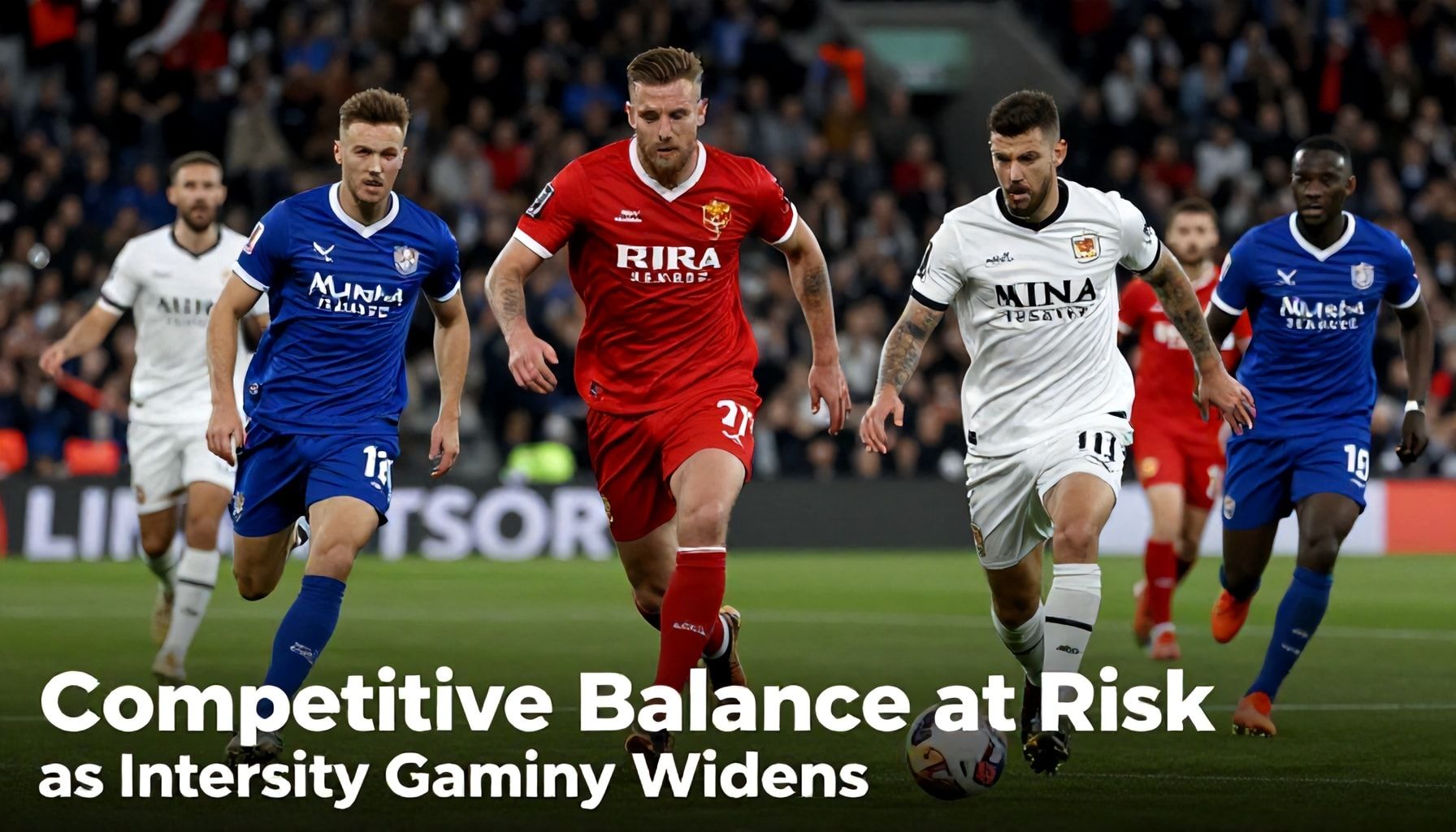
The intensity gap between top European football leagues is widening, threatening competitive balance. UEFA’s latest report reveals the disparity in average points per game between the top and bottom teams has increased by 15% since 2019.
The Premier League shows the most significant gap, with an average of 2.1 points separating top and bottom teams. La Liga and Bundesliga follow closely, with gaps of 1.9 and 1.8 points respectively. Serie A has the smallest gap, at 1.5 points.
Experts attribute the growing gap to financial disparities and the concentration of talent in elite clubs. Dr. Daniel Harris, a sports economist at the University of Manchester, states, “The financial regulations have not kept pace with the commercial growth of the game.”
The intensity gap has consequences for competition and fan engagement. Fewer close matches reduce uncertainty, a key driver of fan interest. The European Leagues’ CEO, Jacob Joseph, warns, “This trend risks making football predictable and less appealing.”
UEFA has acknowledged the issue but has not yet proposed specific measures to address it. The organisation is expected to discuss potential solutions at its next executive committee meeting in March.
As the 2023 season progresses, the widening intensity gap between Europe’s elite leagues and their domestic counterparts becomes increasingly apparent. While the Premier League, La Liga, and Serie A continue to dominate the Champions League, other leagues face the challenge of narrowing this gap. The focus now shifts to how these leagues can develop their own talent and infrastructure to compete at the highest level. With the UEFA coefficient system under review, the stakes are higher than ever for leagues outside the traditional powerhouses. The coming years will be crucial in determining whether the gap continues to widen or if other leagues can bridge the divide.






