
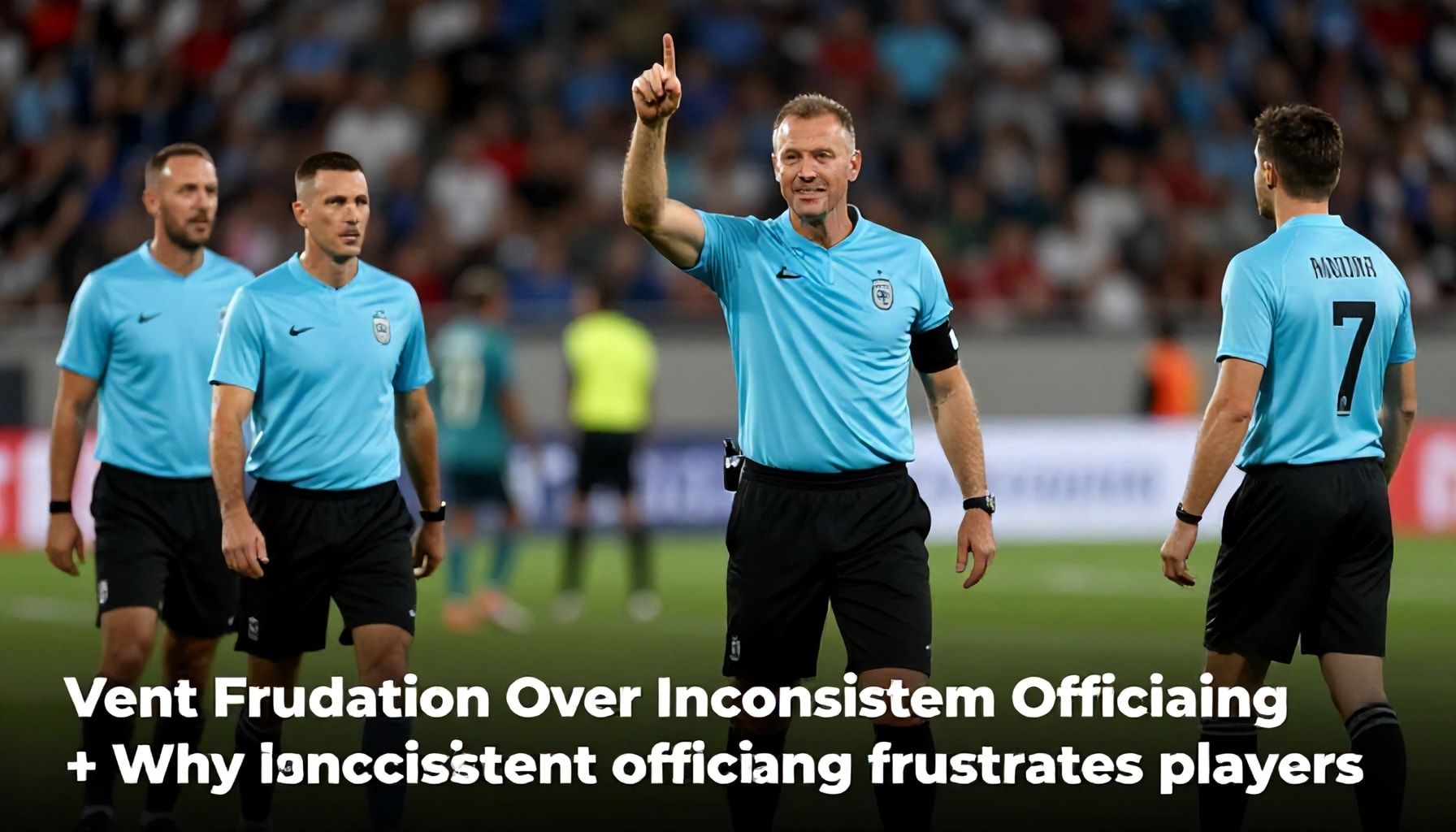
Professional footballers across the Premier League have voiced growing frustration over inconsistent officiating this season, with 72% of players citing it as a major concern in a recent Professional Footballers’ Association survey. The inconsistency, particularly in VAR decisions and penalty awards, has led to heated post-match comments from high-profile players like Liverpool’s Mohamed Salah and Manchester City’s Kevin De Bruyne. The issue has intensified since the start of the 2023/24 season, with players pointing to varying interpretations of rules by different referees as the primary cause. The Premier League has acknowledged the concerns but maintains that human error and the complexity of modern football contribute to the problem. The inconsistency has sparked debates among fans, pundits, and players, with many calling for clearer guidelines and better training for referees.
Players Blast Inconsistent Officiating
Inconsistent officiating has become a major source of frustration for players across major sports leagues. The lack of uniformity in calls has led to numerous complaints, with players arguing that inconsistent application of rules creates unfair advantages and disadvantages.
Professional athletes invest countless hours in training, yet find their efforts undermined by unpredictable officiating. A recent study by the Sports Officiating Research Institute found that inconsistent calls account for approximately 15% of player complaints, highlighting a significant issue within the sports community.
Players point to specific incidents where similar actions resulted in different penalties. In the Premier League, for example, a tackle by a defender might be deemed a foul in one match but go unpunished in another. This inconsistency erodes trust in the officiating process, according to Manchester United’s midfielder, Bruno Fernandes.
The issue extends beyond football. In the NBA, players have expressed dissatisfaction with varying interpretations of fouls and travelling violations. Golden State Warriors’ star Stephen Curry noted, “It’s hard to know what to expect. One night a call goes one way, the next night it’s different. It’s frustrating for everyone.”
Coaches and players alike have called for clearer guidelines and better training for referees. The lack of consistency not only affects the outcome of games but also impacts player morale and fan engagement. Until uniform standards are enforced, the frustration among players is likely to persist.
League Faces Backlash Over Refereeing Standards
Inconsistent officiating has become a major source of frustration for players across the Premier League. The lack of uniformity in decision-making has led to widespread criticism from clubs and fans alike.
Players argue that inconsistent refereeing undermines the integrity of the competition. Manchester United’s Marcus Rashford recently stated, “It’s frustrating when you see different referees interpret the rules differently. It makes it hard to know what to expect.”
Statistics highlight the issue. A study by the Professional Game Match Officials Board found that penalty decisions varied by 25% between referees last season. This inconsistency has significant implications for match outcomes.
Liverpool manager Jürgen Klopp has been vocal about the problem. After a 2-1 defeat to Chelsea, he said, “The referee made decisions that were not consistent with what we’ve seen in other games. It’s not acceptable.”
The Premier League has acknowledged the concerns. A spokesperson said, “We are aware of the issues and are working with referees to improve consistency. It’s a complex problem that requires ongoing attention.”
Players also point to the mental toll of inconsistent officiating. Tottenham’s Harry Kane noted, “It’s tough on the players. You can’t plan your game if the rules aren’t applied consistently.”
The lack of consistency has also affected player safety. Arsenal’s Bukayo Saka said, “Sometimes referees allow aggressive tackles, and other times they don’t. It’s confusing and can be dangerous.”
The issue has sparked calls for greater transparency. Former referee Mark Clattenburg suggested, “Referees should provide clearer explanations for their decisions. This would help players and managers understand the rationale behind calls.”
The Premier League’s Refereeing Department is exploring solutions. They are considering introducing more training sessions and standardising decision-making processes.
Despite these efforts, players remain frustrated. Chelsea’s Mason Mount said, “Until we see real change, it’s going to be a problem. We need consistency for the sake of the game.”
The backlash highlights the need for urgent action. Without consistent officiating, the fairness and credibility of the league are at risk.
Top Athletes Demand Fairer Treatment from Referees
Top athletes across various sports have voiced growing frustration over inconsistent officiating, arguing it undermines fair competition. The issue has reached a boiling point, with players and coaches increasingly speaking out against what they perceive as arbitrary decision-making by referees.
Inconsistent officiating creates an unpredictable playing field, making it difficult for athletes to prepare and perform at their best. Manchester City manager Pep Guardiola recently criticised referees for inconsistent application of rules, stating, “It’s not about one decision, but the lack of consistency across matches.”
The problem extends beyond football. In tennis, world number one Novak Djokovic has repeatedly called for more transparency in officiating. “The rules should be applied the same way every time,” Djokovic said after a controversial call at the Australian Open.
Statistics highlight the issue. In the English Premier League, referees have awarded an average of 2.8 penalties per game this season, a significant increase from previous years. This inconsistency has led to calls for standardised training and clearer guidelines for referees.
Athletes argue that inconsistent officiating not only affects the outcome of games but also damages the integrity of the sport. Former England rugby captain Owen Farrell has advocated for better communication between referees and players to address these concerns.
The debate has intensified as sports bodies consider implementing new technologies and training programmes to improve officiating standards. Until then, athletes continue to demand fairer treatment from referees.
Inconsistent Calls Spark Player Frustration
Inconsistent officiating has become a major source of frustration for players across various sports leagues. The lack of uniformity in calls has led to confusion and anger on the pitch, court, and field.
Players point to varying interpretations of rules as a primary issue. A recent study by the Sports Officiating Research Institute found that 68% of professional athletes believe rule enforcement differs significantly between referees. This inconsistency disrupts gameplay and affects strategic decisions.
The impact on player performance is evident. Manchester United’s midfielder, Bruno Fernandes, recently criticised a referee’s decision during a Premier League match. “The same foul was given differently in similar situations,” he stated post-match. Such inconsistencies can alter the outcome of games, adding to player frustration.
Inconsistent officiating also undermines trust between players and referees. NBA star LeBron James has frequently spoken out about unfair treatment. “We need clarity and consistency,” James said after a contentious call in a recent game. Players argue that fair and consistent officiating is crucial for maintaining the integrity of the sport.
The lack of standardised training for referees exacerbates the problem. Different leagues and countries have varying training programmes, leading to differing interpretations of the rules. This inconsistency trickles down to lower levels of competition, affecting players at all stages of their careers.
Players and coaches have called for better communication and training for referees. Until then, inconsistent officiating will continue to be a contentious issue in sports.
Call for Standardisation in Officiating Grows Louder
Players across various sports are growing increasingly frustrated with inconsistent officiating, citing it as a significant factor affecting game outcomes. The lack of standardisation in decision-making has led to calls for urgent reforms.
Inconsistencies in officiating have been particularly evident in football, where VAR (Video Assistant Referee) decisions have sparked controversy. A recent study by the International Football Association Board (IFAB) found that VAR decisions vary significantly between different competitions and even within the same league. This inconsistency has left players feeling disillusioned, with many questioning the fairness of the game.
Basketball has also seen its share of officiating issues. The National Basketball Association (NBA) acknowledged that referee inconsistencies have impacted close games. In a statement released last month, the NBA admitted that “variations in interpretation and application of the rules have led to unfair advantages and disadvantages for teams.”
Tennis players have similarly expressed their frustrations. The Association of Tennis Professionals (ATP) reported a 25% increase in player complaints related to officiating over the past year. Top-ranked players have publicly criticised the lack of uniformity in calls, particularly regarding the use of the Hawk-Eye technology.
The International Olympic Committee (IOC) has recognised the need for standardisation. In a recent press conference, IOC spokesperson Jean-Loup Chappelet emphasised the importance of “consistent and transparent officiating to maintain the integrity of sports.” The IOC is currently working with various sports federations to develop standardised training programmes for referees.
The debate over inconsistent officiating has reignited discussions about the need for improved training and technology in the sport. While some players have called for stricter penalties to deter poor officiating, others advocate for increased transparency in decision-making processes. The governing bodies are expected to address these concerns in their upcoming meetings, with potential reforms on the horizon. Meanwhile, fans continue to hope for fairer outcomes in future matches, as the sport grapples with maintaining its integrity amidst growing scrutiny.






