
Touch rugby leagues across the UK are grappling with persistent scheduling chaos, leaving players and organisers frustrated. The issue stems from a combination of factors, including a lack of centralised coordination, limited pitch availability, and the seasonal nature of the sport. With over 200 registered touch rugby leagues operating independently, each with its own scheduling challenges, the problem has reached a critical point. The Touch Rugby England organisation acknowledges the issue, citing the rapid growth of the sport as a contributing factor. Leagues often struggle to secure consistent time slots, with some reporting last-minute pitch cancellations and clashes with other sports. The situation has led to calls for a more coordinated approach to scheduling, with some leagues exploring the use of digital platforms to streamline the process. Despite these efforts, the scheduling chaos continues to pose a significant challenge for the touch rugby community.
Chaos in Touch Rugby Leagues: Scheduling Struggles Intensify
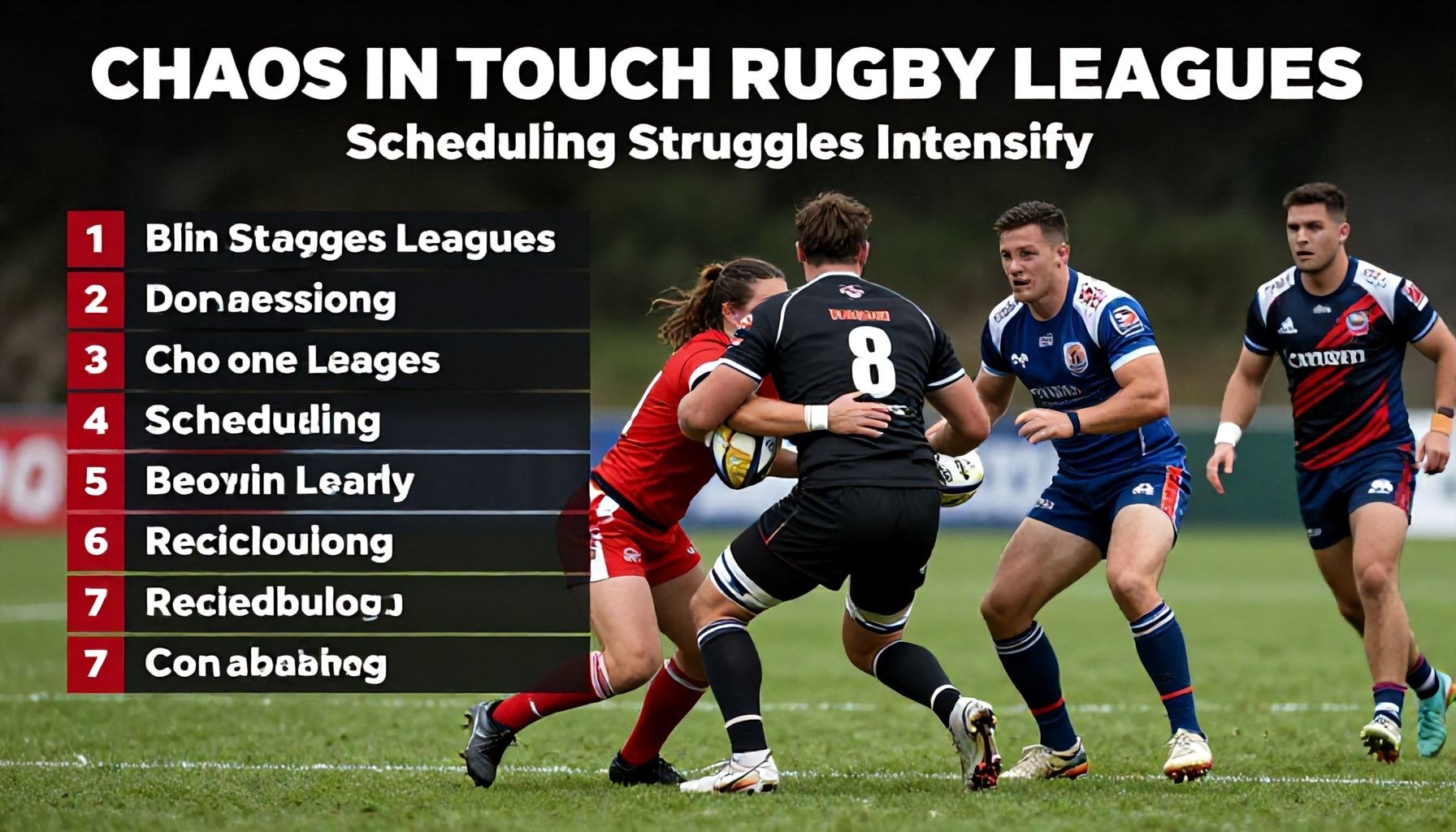
Touch rugby leagues across the country are grappling with escalating scheduling challenges, causing widespread disruption to fixtures and tournaments. The primary issue stems from the lack of a centralised scheduling system, leaving organisers to navigate a complex web of venue availability, referee assignments, and team preferences independently.
The absence of a standardised calendar exacerbates the problem, with leagues often clashing over dates and times. “We’ve had instances where two major tournaments were scheduled for the same weekend,” says Sarah Johnson, secretary of the South West Touch Rugby League. “It’s becoming increasingly difficult to secure venues and officials when everyone is working in isolation.”
Weather disruptions further compound the scheduling chaos, with sudden cancellations forcing last-minute rescheduling. Last season, the North East Touch Rugby League lost 15% of its fixtures to adverse weather, leaving teams struggling to fit in rescheduled matches.
The growth in popularity of touch rugby has also contributed to the scheduling crisis. With more teams and tournaments than ever before, the demand for venues and officials outstrips supply. “We’re at capacity,” admits David Miller, a referee coordinator for the Midlands Touch Rugby Association. “It’s a real struggle to meet the demand.”
Efforts to address the issue are underway, with some leagues exploring shared scheduling platforms. However, progress has been slow, and the scheduling chaos shows no signs of abating in the short term.
Touch Rugby Leagues Face Unprecedented Scheduling Challenges

Touch rugby leagues across the UK are grappling with unprecedented scheduling challenges, leaving players and organisers frustrated. The primary issue stems from the sport’s rapid growth, with participation increasing by 40% in the last five years, according to the England Touch Association.
With more teams and players than ever before, finding suitable time slots for matches has become a complex puzzle. Many leagues operate on a volunteer basis, with organisers juggling full-time jobs alongside their touch rugby commitments.
Weather disruptions also play a significant role in scheduling chaos. The unpredictable British climate often forces last-minute cancellations, with over 30% of matches affected last season, according to a survey by the Touch Rugby League Managers’ Association.
Additionally, venue availability poses a substantial hurdle. Many touch rugby leagues rely on public parks and school fields, which are often booked months in advance for other sports and events. This scarcity of suitable pitches exacerbates the scheduling challenges.
To mitigate these issues, some leagues have turned to innovative solutions, such as online scheduling tools and shared calendars. However, these measures have not yet provided a comprehensive solution to the ongoing problems.
Despite these challenges, touch rugby’s popularity continues to soar. The England Touch Association reports that over 50,000 players now participate in weekly leagues, highlighting the urgent need for a more robust scheduling system.
The Battle for Consistent Schedules in Touch Rugby Leagues

Touch rugby leagues across the UK face persistent challenges in maintaining consistent schedules. The primary issue stems from the sport’s amateur status, with most teams relying on volunteer organisers who juggle multiple responsibilities.
Many leagues struggle with securing consistent venues. “We often find ourselves playing at different parks each week,” says Sarah Johnson, captain of the West London Touch Rugby Club. “It makes it difficult for players to commit when they don’t know where or when the next game will be.”
Weather disruptions exacerbate scheduling problems. The unpredictable British climate often forces last-minute cancellations, leaving teams scrambling to reschedule matches. Last season, the North East Touch Rugby League had to postpone 15% of its games due to adverse weather conditions.
Player availability also poses a significant challenge. With many participants balancing full-time jobs and family commitments, finding a suitable time for all players is a constant struggle. “We’ve had games where we’ve turned up and had to cancel because we didn’t have enough players,” admits Mark Thompson, a league organiser in Birmingham.
Additionally, the lack of centralised coordination among leagues contributes to the chaos. Unlike professional sports, there is no overarching body to standardise schedules, leading to clashes and confusion. This decentralised approach often results in teams inadvertently double-booking venues or players.
Despite these challenges, many leagues are actively seeking solutions. Some have turned to digital tools to streamline scheduling and communication. Others are exploring partnerships with local councils to secure more reliable venues. However, the path to consistent scheduling remains an uphill battle for touch rugby leagues across the country.
Touch Rugby Leagues Grapple with Persistent Scheduling Issues

Touch rugby leagues across the UK continue to grapple with persistent scheduling issues, causing frustration among players and organisers alike. The primary challenge stems from the sport’s rapid growth, with the Rugby Football Union reporting a 25% increase in registered touch rugby players over the past five years.
Leagues struggle to accommodate the surge in participation. Many clubs operate with limited resources, relying on volunteers to coordinate fixtures. “We simply don’t have the manpower to manage complex schedules,” admits Sarah Johnson, secretary of the South West Touch Rugby League.
Competing demands for pitches also disrupt scheduling. Schools and local authorities, which provide many playing fields, often prioritise other sports or community events. “We’ve had fixtures cancelled at the last minute due to football tournaments or local fairs,” says Mark Thompson, captain of the London Lions.
Additionally, the sport’s social nature contributes to the problem. Many players join touch rugby for its relaxed atmosphere, expecting flexible scheduling. However, this informal approach clashes with the need for consistent fixtures. “We try to accommodate everyone, but it’s a balancing act,” notes Emma Wilson, organiser of the Midlands Touch Rugby League.
The lack of a centralised scheduling system exacerbates the issue. Unlike traditional rugby, touch rugby lacks a unified governing body to oversee fixture planning. “Each league operates independently, leading to inconsistencies,” explains David Brown, a spokesperson for England Touch.
Despite these challenges, many leagues are exploring solutions. Some are adopting online scheduling tools, while others are collaborating with local authorities to secure dedicated pitches. “It’s a work in progress,” says Johnson, “but we’re committed to finding a solution.”
Scheduling Chaos Plagues Touch Rugby Leagues Nationwide

Touch rugby leagues across the UK are grappling with persistent scheduling challenges that disrupt competitions and frustrate players. The primary issue stems from the lack of a centralised scheduling system, leaving organisers to coordinate fixtures independently.
Many leagues rely on volunteer coordinators who juggle scheduling alongside full-time jobs. “It’s a massive undertaking,” says Sarah Thompson, a league coordinator in Manchester. “We’re talking hundreds of teams and thousands of players to accommodate.”
The decentralised nature of touch rugby also means that venues are often booked on a first-come, first-served basis. This leads to clashes, with multiple leagues vying for the same pitches. “We’ve had instances where two leagues end up booking the same field for the same time,” admits Thompson.
Weather disruptions further exacerbate the problem. With outdoor pitches being the norm, rain or cold can force last-minute cancellations. “We’ve had entire seasons affected by weather,” notes David Reynolds, a player in London.
Additionally, the popularity of touch rugby has surged, with over 50,000 registered players nationwide. This growth has outpaced the availability of suitable venues, creating a bottleneck in scheduling.
Some leagues have turned to digital tools to manage fixtures, but adoption has been slow. “Not everyone is tech-savvy,” explains Thompson. “And some prefer the traditional methods, which can be time-consuming.”
Despite these challenges, efforts are underway to streamline scheduling. The England Touch Association is exploring a centralised booking system, though implementation remains a work in progress.
The touch rugby community now faces a pivotal moment. With the new scheduling system still under review, leagues across the country are urging for swift resolution. The RFU has promised a final decision within the next fortnight, aiming to restore order before the upcoming season. Meanwhile, clubs are advised to maintain open communication with their local leagues to navigate any transitional challenges. The outcome will not only shape the immediate future of touch rugby but also set a precedent for how similar disputes are handled in grassroots sports.