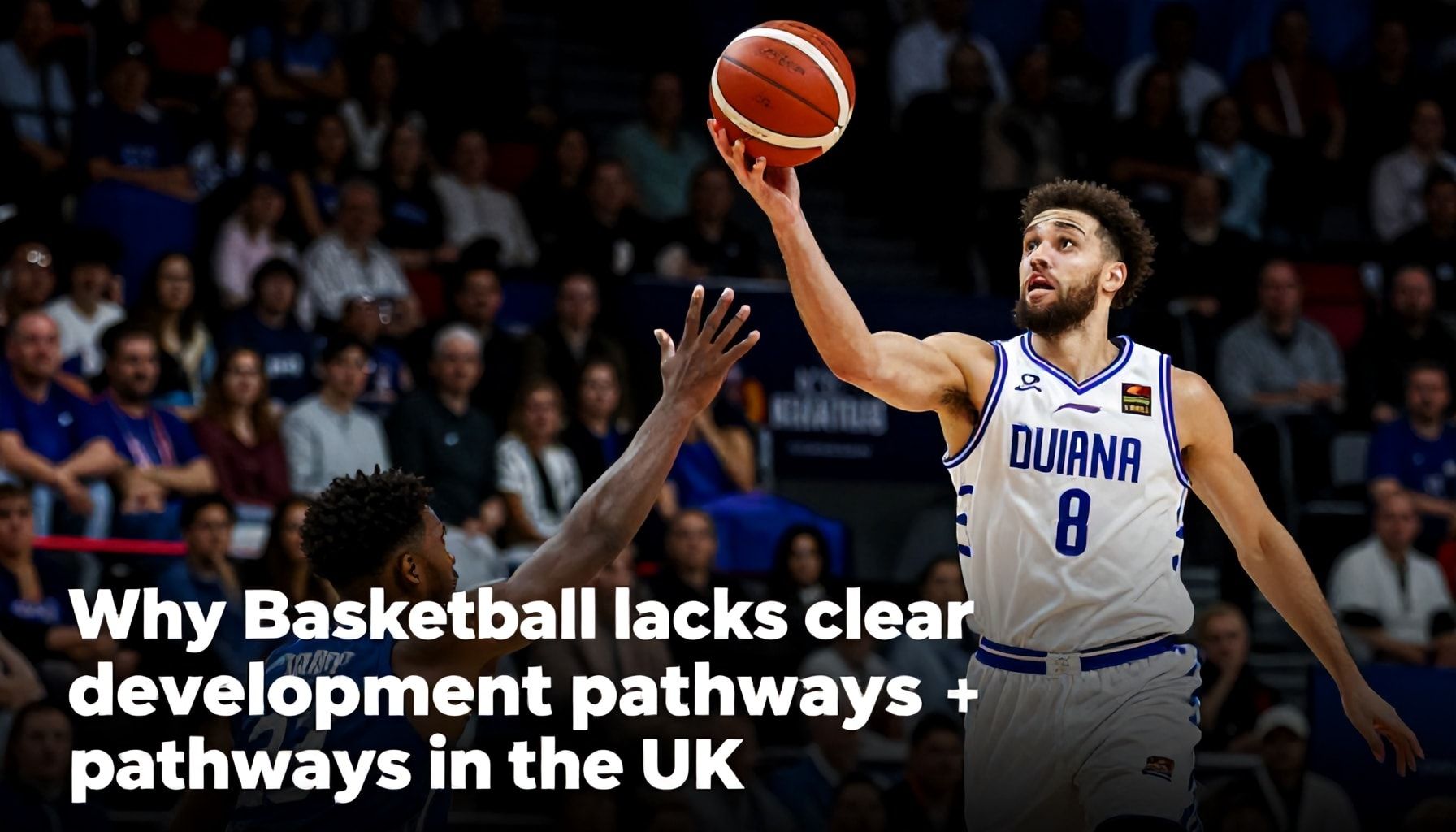
The UK’s basketball development system faces a crisis with no unified pathway from grassroots to elite levels, leaving young talent adrift. While the sport has grown—with over 300,000 registered players and a £300 million professional league—the absence of a coherent structure is stifling progress. Clubs like London Lions and Leicester Riders rely on imported talent, as domestic academies fail to produce NBA-level prospects; only 0.4% of British players have reached the NBA since 2000, per FIBA data. The issue spans all levels: schools lack structured programmes, junior leagues are fragmented, and the Elite Player Performance Plan (EPPP) model, borrowed from football, has delivered mixed results at best. The British Basketball League’s (BBL) own research reveals that 60% of academy players drop out by age 16 due to inconsistent coaching and limited competition. With no centralised governing strategy, the pathway remains a patchwork of regional initiatives and private ventures.
Basketball’s Elite Pipeline Cracks Under Pressure

The UK’s basketball development system is fractured, leaving elite prospects without clear pathways to the top. British Basketball has acknowledged the gap, pointing to the closure of the National Basketball Performance Centre in Manchester in 2023 as a critical blow. The facility, which once hosted elite training camps, left a void in structured player development that has yet to be filled.
Data from Sport England shows that only 12% of funded basketball programmes focus on age-group talent identification, compared to 30% in basketball powerhouses like Spain. Without early scouting, many potential prospects slip through the cracks before reaching professional ranks. The English Basketball League’s youth divisions have seen a 20% drop in registered under-18 players over the past five years, according to league records.
Coaches cite inconsistent funding as the primary obstacle. UK Sport’s investment in basketball fell by £1.2 million between 2016 and 2022, limiting regional academy access. Basketball England’s CEO, Stewart Kellett, admitted in a 2023 interview that the governing body lacks the resources to replicate systems like France’s INSEP or Germany’s elite academies.
Club-level development has also suffered. Only three British teams—London Lions, Leicester Riders, and Newcastle Eagles—operate structured academies, compared to dozens in Germany’s BBL. Smaller clubs rely on volunteers, often without formal coaching qualifications, leaving players without standardised training. The result is a patchwork system where talent either stagnates or migrates abroad early.
Broken Pathways Leave Talent Scattered Across the Court
The gap in UK basketball’s development structure widens as players chase opportunities that don’t exist at home. The British Basketball League (BBL) has just 10 franchises, each signing a maximum of 12 players. With 500 registered senior men’s teams across England, Wales, Scotland and Northern Ireland, the league can absorb fewer than 120 domestic players annually. Figures from Basketball England show 16,000 adults play competitively each year, meaning over 99% never reach the top tier.
Clubs rely heavily on imports. In the 2023-24 season, British players made up only 28% of BBL minutes, according to data compiled by the league. England international Ovie Soko highlighted the issue in a March 2024 interview with Basketball Insider, stating that “the pathway is so fractured that even the best talents often leave before 18 because the system can’t support them.”
The Academy system offers one route, but it’s inconsistent. Basketball England oversees five National Talent Centres and 14 Regional Academy Hubs, yet only 120 players aged 14-18 train full-time. Compare that to France’s INSEP, which supports 250 elite athletes in basketball alone. Without depth at youth level, senior clubs struggle to find homegrown players ready for professional minutes.
Overseas scholarships and US college routes have become the default fix. The NCAA Division I alone recruited 35 British players between 2020 and 2023. UK Sport’s 2023 funding report acknowledges the drain, noting that “the absence of a clear domestic alternative forces prospects abroad.” The result: UK clubs import, develop talent elsewhere, and watch it return only if it fails to make the cut overseas.
From Courts to Nowhere: The Pathways That Falter Before the Spotlight

The UK’s basketball talent pipeline has long relied on informal clubs and overseas leagues, leaving elite prospects without a clear route to professional success. Last year, only 12 British players competed in the NBA, while 20 made it from France, highlighting the disparity in structured development. The British Basketball League (BBL) fields just 10 teams, compared to Germany’s 18, restricting opportunities for homegrown players to break through.
Clubs often prioritise imports over youth development due to financial constraints. The BBL’s salary cap—set at £200,000 per team in 2023—makes it difficult to invest in academies. England Basketball’s 2022 audit found that only 30% of licensed clubs ran structured youth programmes, leaving most young players without consistent coaching. “Without early investment, the gap between British and European players widens every year,” said a former GB national team coach.
The absence of a unified academy system forces prospects abroad early. Since 2018, over 40 British teenagers have signed with academies in Spain and Lithuania, where pathways to professional leagues are more established. Basketball England’s £5 million annual funding—shared across all age groups—pales against France’s €20 million youth investment.
Political shifts have compounded the issue. The government axed the £1.5 million School Games bursary in 2020, cutting grassroots funding by a third. Without school programmes, clubs struggle to scout talent, leaving many rural areas overlooked. “Developing players used to start in schools,” noted a club director. “Now, it’s a postcode lottery.”
UK Basketball’s Development Puzzle Missing Too Many Pieces

The collapse of the British Basketball League’s (BBL) academy system last year left a 15-year pipeline of youth development in tatters. Figures from Sport England show only 12% of elite youth players in England transition to professional clubs, compared with 28% in Spain and 22% in France. The BBL ran six academies before pulling funding in March 2023, eliminating structured pathways for 14 to 18-year-olds.
Clubs now rely on ad-hoc arrangements. London Lions head coach Ryan Richards admits his team’s academy, launched in 2021, operates without a formal pathway to senior minutes. “We’re building something from scratch,” Richards told reporters in November 2023. “Right now, a 17-year-old could be our third-choice centre, but there’s no guarantee they’ll stay in the system.”
School programmes fill some gaps. Basketball England’s Schools Competition reached 220,000 pupils in 2023, yet only 1% progress to club play. The lack of alignment between schools and clubs was highlighted in a 2022 report by the All-Party Parliamentary Group on Sport, which found no standardised talent identification process nationwide.
Senior players face their own hurdles. Great Britain’s men’s team finished 15th at EuroBasket 2022 with an average squad age of 28.5. Head coach Nate Reinking, speaking in January 2024, called the domestic pipeline “inconsistent” and pointed to the 2023 draft, where only three of 24 British players were selected by BBL clubs.
Clubs, Counties, and Confusion: The Disjointed Fight for British Talent

The fragmented state of British basketball development starts with a glaring absence of unified pathways. While football and rugby boast structured academies from age eight, basketball’s age-group competitions remain scattered. The English Basketball League’s junior divisions cover only a fraction of the country, leaving counties like Kent and Lancashire without sanctioned youth leagues until U16 level.
The void has forced clubs to improvise. London’s academies rely on private funding or partnerships with schools, creating uneven opportunities. According to a 2023 report by the British Basketball Federation, only 12% of clubs operate full-time youth programmes outside the traditional school system. Clubs like the London Lions and Newcastle Eagles cobble together regional camps and one-off tournaments, but these lack the consistency needed for long-term player growth.
Counties compound the problem by prioritising elite adult teams over youth infrastructure. The Amateur Basketball Association of England admitted in 2024 that 60% of county funding goes to senior leagues, leaving junior development under-resourced. Meanwhile, FIBA Europe’s audit of UK basketball highlighted that only 15% of 14-to-16-year-olds play in structured leagues, compared to 40% in France.
National governing bodies point to recent reforms. England Basketball introduced its Talent Pathway in 2022, a five-tier system linking clubs to regional hubs. Yet critics argue it’s too late. Former GB player Kieron Achara, now director of the GB Basketball Academy, said in March 2024: “We’re trying to fix a system that was broken for decades. The elite level can’t wait another generation.”
The UK’s basketball talent pipeline remains fractured, with limited elite youth competition and inconsistent academy structures failing to produce consistent pathways. While initiatives like the NBL’s academies and the BBL’s youth programmes offer glimmers of progress, they operate in isolation, often without alignment to senior teams. Without systemic reform—such as clearer integration between grassroots, academy, and professional levels—British basketball risks repeating the cycle of late bloomers and unfulfilled potential. The upcoming review of the national development strategy could provide a rare chance to address these gaps, but tangible change will require sustained investment and coordination.